
Your Attic Experts.
categories
SHARE
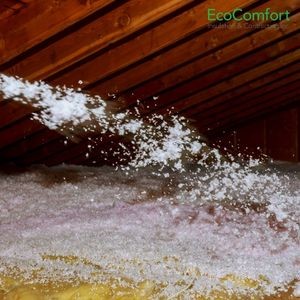
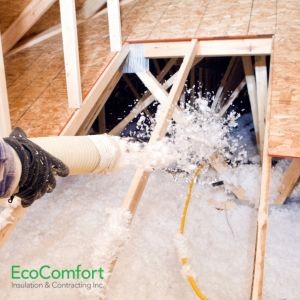
In the attic and roof cavity, blown-in attic insulation is one of the more cost-effective installations. At EcoComfort, we install two types of blown-in attic insulation – blown-in fibreglass and blown-in cellulose. Each product has pros and cons, while providing satisfactory insulation performance.
While many of our customers have realized better results with blown-in cellulose, every attic is unique, and with unique requisites. As it is, we’ll assess your particular needs and recommend an appropriate product and installation. What’s important is to provide good return-on-investment.
For homeowners considering blown-in attic insulation, blown-in fibreglass may be the product to choose. Basically, it’s made of glass fibres that are spun into a fluffy insulating material. Blown-in fibreglass is a good option for topping up existing attic insulation – it doesn’t compress and it will not measurably settle. As such, it provides satisfactory thermal performance where it’s installed.
Blown-in fibreglass delivers good R-Values and performs well in fire tests – after all, it’s made of glass and does not burn in high temperatures. As well, the fibreglass product is quite resistant to mould growth. In terms of installation, blown-in fibreglass is a cost effective product option that will ensure improved energy efficiency along with much reduced annual heating and cooling bills.
Another option for blown-in attic insulation is the cellulose product. Blown-in cellulose is derived from plant cellulose, and is often manufactured using recycled paper. It’s an eco-friendly product that satisfies the preference of homeowners who want to install this type of insulation material.
Thermal performance compares favorably with other insulation products. The installation is ideal for “topping up” existing insulation, as long as the material is dry and uncontaminated.
Cellulose insulation is fire resistant – it limits any oxygen availability and prevents the spread of fire. In tests, cellulose insulation has proven to be up to 50% more resistant than other materials.
Blown-in cellulose is perfect for insulating those “hard-to-reach” spaces, especially in the attic. Professionally installed, the insulating material fills cavities much better than the batt insulation.
When it comes to installation, blown-in cellulose requires less time and labour than other installs. It’s a very cost effective installation, with lower costs than many of the other insulation products.
Blown-in cellulose provides many years of enhanced energy efficiency, with substantial savings on winter heating and summer air conditioning (it’s one of the better returns-on-investment).
When professionally installed, blown-in cellulose reduces sound coming from inside or outside of the home. This is especially beneficial for residents living in semi-detached units or townhomes.
Blown-in cellulose contains NO formaldehyde, NO asbestos, and NO toxic chemicals. The material is treated with boric acid, therefore providing excellent mould resistance and insect repellency.
For customers in Toronto and throughout the GTA, EcoComfort offers various options for blown-in attic insulation. Our experts will help you to choose the right product and installation for your needs. With so many different insulation products on the market, we still recommend blown-in cellulose and stand behind the quality and performance.
Book an Attic Inspection Today by Calling 416-333-4554.
Why Homeowners Should Consider Attic Insulation Removal in the Spring?
Spring tends to be a transitional season when it comes to Canadian weather. With constant temperature changes and increased precipitation, homeowners rely heavily on attic insulation to keep their...
Why Improve the Air Tightness of Your Attic
When addressing issues like drafts and rising energy bills, many homeowners may not realize how much their attic can impact their entire home’s comfort and efficiency. Poor attic ventilation and...
Signs Your Attic Insulation Has Settled
When attic insulation settles and flattens, its performance starts to decline pretty quickly. As a result, you may experience challenges and signs when inside your home. Under-performing or damaged...